The following lecture notes were originally devised for the Nanjing University International Summer School: Art, Artificial Intelligence, and Global Humanities (June 29-July 13, 2025). They are accompanied by a series of study resources and Intertext →, which in the spirit of Roland Barthes’ Neutral lectures, provides ‘a list of the texts whose reading, in various ways, has punctuated the preparation’ of the materials. In this case, it is a dynamic list, which the user can determine through a series of keyword prompts.
Lecture 1: AI, Knowledge & Electronic Life
The lecture will set out some of the history and innovations of Artificial Intelligence (AI), understood as a ‘constellation’ of technologies and techniques. Recent advancements following the ‘Statistical Turn’ (and notably Deep Learning) give rise to the suggestion of a new industrial (and scientific) revolution. Drawing upon examples of art, writing and image making, the lecture will take a long view of knowledge and archive and pose a question about an emerging post-knowledge condition.
Lecture 2: Anthropological Algebra
The seminar introduces Prof. Manghani’s current research, which focuses on the application of structuralism (prominent in linguistics, anthropology and semiology in the mid-twentieth century) to contemporary AI methodologies. The work poses questions about how current techniques, particularly regards Large Language Models, might include additional layers or ‘structures’ of meaning to account for cultural meaning as much as semantic fluency. A underlying question is how we can understand AI techniques in relation to ‘discovery’ and the formulation of new knowledge.
Lecture 3: In the Age of the Technological Singularity
Current Large Language Models are trained on 100s of terabytes of data – which in human terms is equivalent to nearly 4 million years of continuous reading (and with the ability for near instant recall of muti-dimensional patterns). This lecture will speculate seriously on the so-called Singularity (the point at which AI surpasses human intelligence and control), to explore the idea of ‘Electronic Life’ (prefaced in the opening lecture) and the weird and wonderful ‘worlds’ of quantum computing and a Mathematical Universe.
§
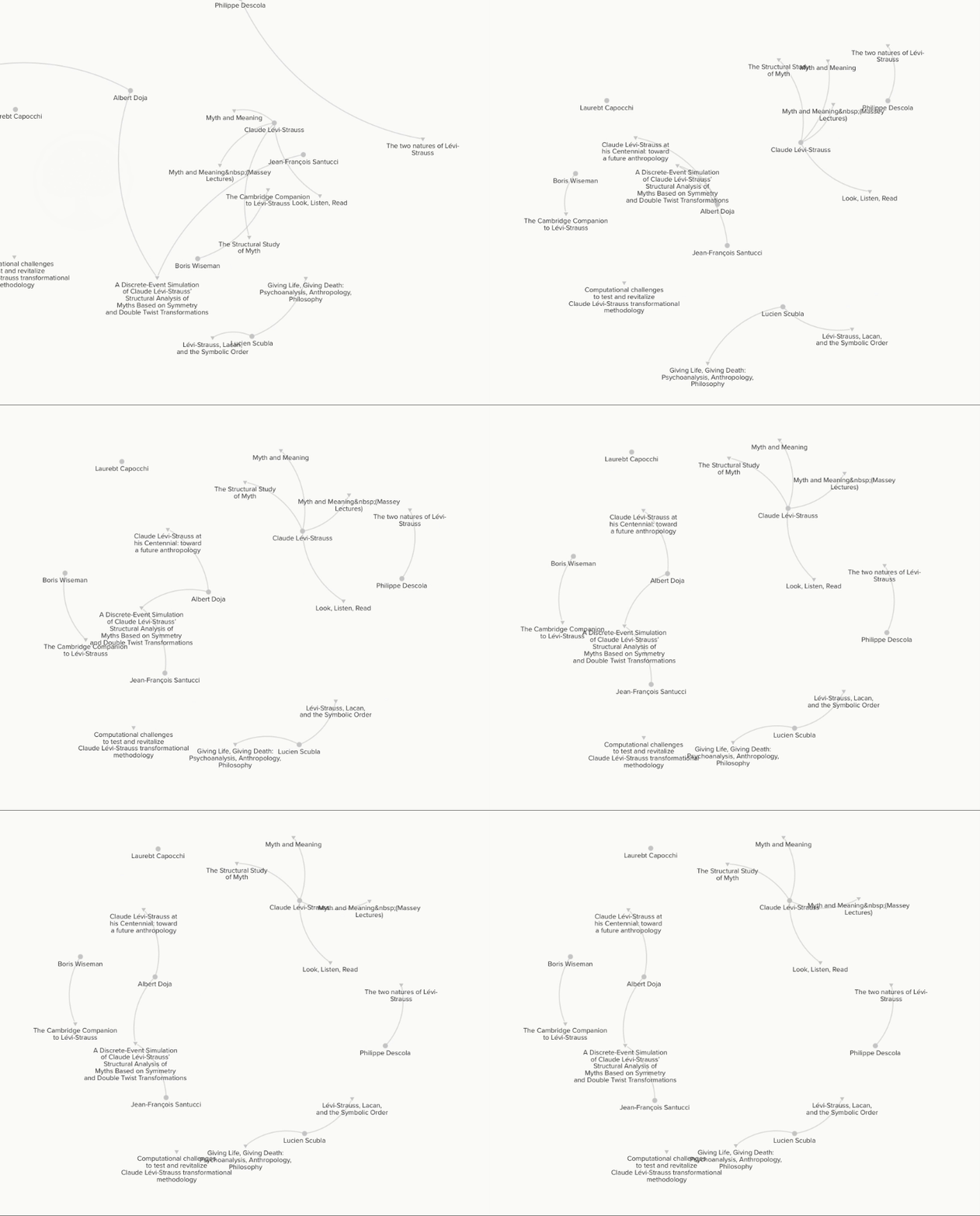
ENTER: INTERTEXT→
[Intertext] is nothing more than a list of the texts whose reading, in various ways, has punctuated the preparation of this [research].
Intertext uses a visualization platform (Kumu) to map a wide range of reference materials as they accrue through the unfolding research. It should not be viewed as a comprehensive bibliography; even if such a bibliography were possible. Rather, to borrow Roland Barthes’ use of the term:
TAGS: The materials have been categorised according to various ‘tags’, including: Algorithmic | Anthropology | Artificial Intelligence | Computation | Computer Vision | Cybernetics | Data | Greimas | Information | Internet | Jakobson | Lacan | Language | Lévi-Strauss | LLMs (Large Language Models) | Machine Learning | Mathematics | Morphology | Myth | NLP (Natural Language Processing) | Neural Networks | Neuroscience | Physics | Psychoanalytic | Semiotic | Structuralism |
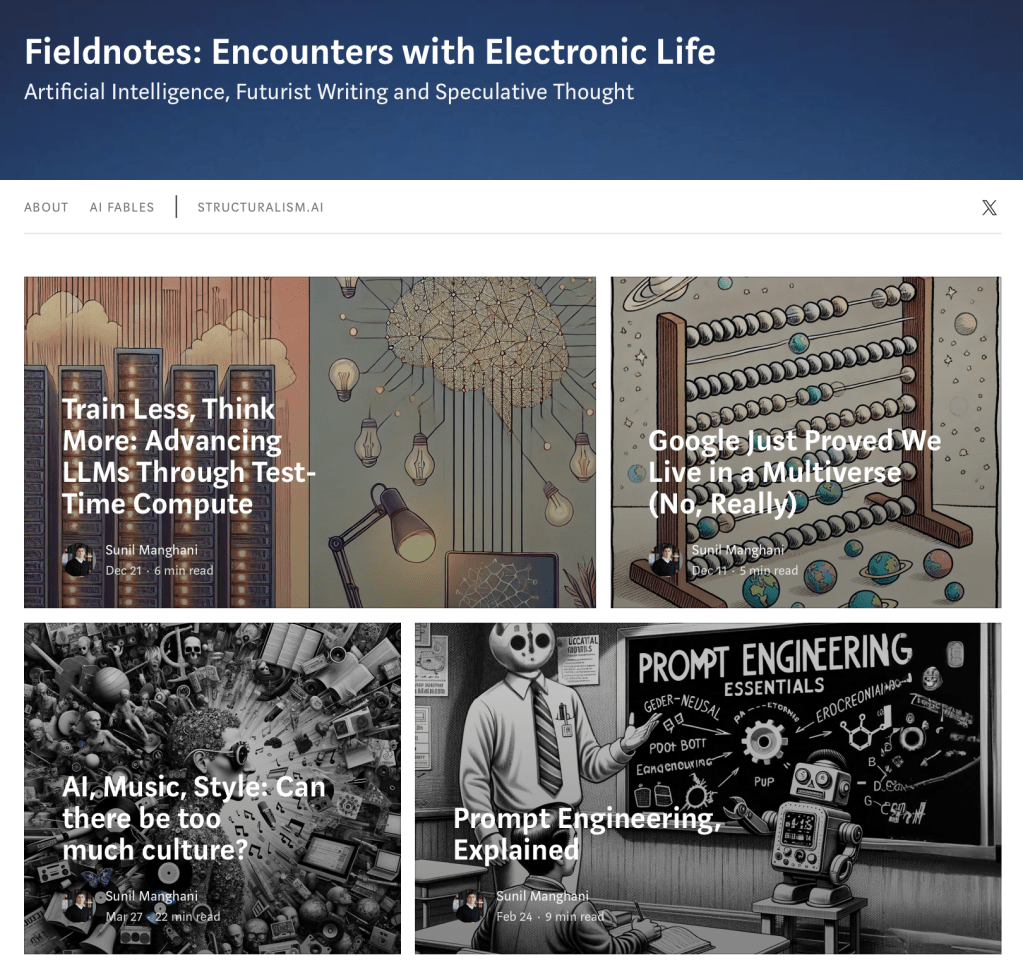
Fieldnotes: Encountering Electronic Life
Articles on artificial intelligence, futurism and speculative thought (via Medium).
The Alan Turing Institute AI & Arts Group →
See also: Reading Group → (denoting items set for a Reading Group established in the first stage of the Fellowship).
 Notes on Structuralism & AI