The Raw and the Cooked
Empirical Categories
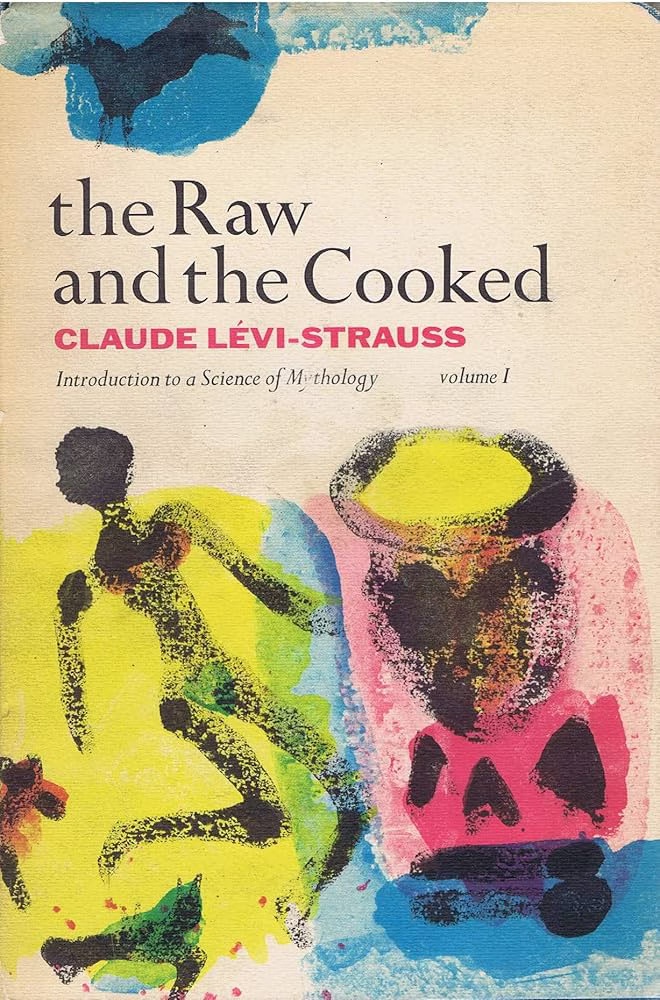
For Lévi-Strauss ‘empirical categories’ (eg. the raw and the cooked, the fresh and the decayed, the moistened and the burned), can only be accurately defined by ethnographic observation. Nonetheless, these categories can be ‘used as conceptual tools with which to elaborate abstract ideas and combine them in the form of propositions’.
Hence, while working at the ‘concrete level’ (empirically; among groups of communities), the ambition is more universal: ‘Using a small number of myths … as a laboratory,’ he writes, ‘I intend to carry out an experiment which … will be of universal significance, since I expect it to prove that there is a kind of logic in tangible qualities, and to demonstrate the operation of that logic and reveal its laws’.
The analysis of myth works syntagmatically rather than paradigmatically by examining how narrative elements combine and relate to each other in sequence, rather than focusing on substitutable symbolic meanings. His method traces how mythemes (fundamental units of myth) connect and progress through the story’s structure, revealing patterns in how societies organize meaning through narrative relationships, rather than treating myths as collections of interchangeable symbols that can be understood in isolation.
Working syntagmatically rather than paradigmatically, Lévi-Strauss wants to avoid arbitrary interpretations (whereby divergences among myths are read as the ‘outcome either of logical transformations or historical accidents’):
…for it is always possible to choose the most convenient interpretation and to press logic into service whenever history proves elusive, or to fall back on the latter should the former be deficient. Structural analysis would, as a result, rest entirely on a series of begged questions, and would lose its only justification, which lies in the unique and most economical coding system to which it can reduce messages of a most disheartening complexity, and which previously appeared to defeat all attempts to decipher them. Either structural analysis succeeds in exhausting all the concrete modalities of its subject, or we lose the right to apply it to any one of the modalities. (Lévi-Strauss)
Anatomy of the Mytheme
At the start of Part Four of The Raw and the Cooked, Lévi-Strauss sets out specific terminology:
- Armature = combination of properties
- Code = patterns of functions of properties
- Message = subject matter of individual myths
Messages (the formulation of individual myths) are numerous; this is to refer to the variance of myths. Yet, the set of myths contain a collection of shared properties. This is the level of the mytheme, or armature, which we can understand as a recurring set of properties. In the set of myths (M1-12) from Part One of The Raw and the Cooked, the properties include, for example, the protagonist, the jaguar, wife-giver, wife-taker, wild pigs. These establish the armature of the myths, which allows Lévi-Strauss to argue for common consideration of the origins of fire and of nature/culture divides. However, there are specific differences in how the properties are organised or ‘coded’.
We might consider the mytheme akin to the pieces of a chess set (these remain invariant). The code is more like the notation of a game of chess (how it is executed). The notation mean that the game can be replayed. In each case the game (as if an utterance) is the message.
How do we move from message to code, and then to compare the relevant codes to determine the armature?
Mytheme-Level ‘Thinking’
LLMs have proven adept at ‘coding’ messages. In other words, they can emulate plausible connections between words and categories or ‘patterns of functions of properties’ in order to render plausible messages (stories, statements, communications). However, without the deeper sense of the armature, the outputs of LLMs remain hollow.
If LLMs could begin to ‘understand’ or handle the possible combination of properties (ie. armature) more directly, they could (a) offer higher level handling of language and ideas; (b) begin to create meaning, by manipulating and re-structuring existing combinations. Advances in knowledge, for example, require a transcendental logic to see beyond what is already known. This relates to Kant’s transcendental deduction, where reason can grasp the conditions that make experience possible, even though these conditions themselves lie beyond direct experience. Just as Kant argued that we can understand the necessity of causality without ever directly observing it, an advanced AI system might grasp the underlying structures that generate meaning, rather than just processing surface patterns. For instance, while we cannot directly observe gravity as a force, we can deduce its necessary existence by understanding how objects must behave in relation to each other – this exemplifies how thought can transcend its immediate limitations to grasp deeper organizing principles. Similarly, an AI system might move beyond pattern recognition to understand the generative rules that make patterns possible in the first place.
In more practical or technical terms, the integration of ‘mytheme-level’ (armature) reasoning into AI reinforcement learning could fundamentally transform how systems learn and generalize by moving beyond mere reward optimization to understanding the underlying structures that make rewards meaningful.
Currently, reinforcement learning operates through trial-and-error within predefined reward structures – essentially learning what actions lead to desired outcomes within given parameters. However, a mytheme-based approach would enable systems to reason about the conditions that make these reward structures possible in the first place. This could manifest in several ways:
- Meta-learning Architecture: Instead of just learning optimal policies within a given environment, systems could begin to understand the abstract principles that generate successful policies across different environments. This would be analogous to how humans don’t just learn specific skills, but grasp the underlying principles of how learning itself works.
- Structural Inference: Rather than simply mapping correlations between actions and rewards, systems could begin to infer the necessary conditions that must exist for certain outcomes to be possible. For example, rather than just learning that certain moves win in chess, the system could understand the fundamental principles of spatial control and temporal advantage that make winning possible.
- Generative Understanding: This approach could enable systems to generate new problem-solving frameworks rather than just optimizing within existing ones. The system would not just find optimal solutions within given constraints but could reason about different possible constraint systems themselves.
A key difference would be the shift from learning within fixed frameworks to understanding and manipulating the frameworks themselves – moving from “what works” to “why it works” and ultimately to “what could work.” This approach could help address one of the fundamental limitations of current AI systems: their inability to truly generalize beyond their training data. By understanding the conditions that make knowledge possible rather than just accumulating specific knowledge, systems could develop more robust and flexible forms of intelligence.
The practical challenge lies in designing architectures that can support this kind of meta-level reasoning while remaining computationally tractable. It might require new forms of neural network architecture that can represent and manipulate abstract structural relationships, or hybrid systems that combine traditional reinforcement learning with more explicit forms of logical reasoning.
Getting Started
One of the difficulties in understanding Lévi-Strauss’ analysis of myth is that his account of specific myths or sets of myths accumulate through a series of layered interpretations. The key myth (M1) in The Raw and the Cooked, for example, is first considered for its portrayal of incest, yet, equally, Lévi-Strauss’ notes how the story betrays an indifference towards incest (and that vengeance, not incest drives the stories). As the analysis M1 unfolds over several chapters, the indifference is instructive. While we might consider incest (and rape, in M1) to be highly problematic, the structural analysis is not focused on literal meanings. It is not focused on plot, for example. Instead, as outlined above, the various elements of the story are to be read as set ‘properties’ which are operated or ‘coded’ in different ways.
M1, M2 and M5 are the focus of the initial analysis, showing how the stories relate to the origins of water. More specifically, there is a difference established between celestial (up) and terrestrial (down) water, being respectively harmful and beneficent. Again, structural analysis is not looking for fixed meanings, instead Lévi-Strauss’ aim is ‘to reveal, through the context … relative significance in a system of contrasts endowed with an operational value’. Adding: ‘symbols have no intrinsic and invariable significance; they are not independent in relation to the context. Their significance is primarily positional’.
On a practical level, we need to determine and locate the salient terms (which make up the combination of properties) and then extract the relational (positional) significance, the system of contrasts or operators.
M5, for example, provides an account of the origin of diseases, but similar to M1 and M2, it is more fundamentally concerned with life/death, with disease as an intermediary:
Like M1 and M2, M5 has an obviously etiological character: it explains the origin of diseases, whereas the Baitogogo myth gives first an explanation of the origin of terrestrial water, then of ornaments on the one hand and of funeral rites on the other. Now, just as these rites mark the passage from life to death (whereas ornaments indicate the reverse), so diseases, which are an intermediary state between life and death, are sometimes considered in America as being like a garment (this is especially true of their common manifestation, a high temperature). (Lévi-Strauss)
In running the myths together, as a ‘complete cycle’, Lévi-Strauss starts to show how the same armature (combination of properties) can be coded in different ways to show equivalences, yet also transformations. So, for example, he suggests:
M2 = origin of adornments (a) and funeral rites (r)
M5 = origin of disease (d)
Whereby:
a, r = 𝑓 (death → life) [e.g. inanimate objects as ‘adornments’ are given ‘life’]
d = 𝑓 (life → death) [disease mediates from life to death]
What starts to emerge are structural patterns. Again, the emphasis is less on the contents of the message, but instead on how the messages carry these ‘structures of thought’ (bound by mythemes, by certain combinations of properties), and which in turn across the myths reveal possible ways of thought.
What we need to look for are relations, mediations and transformations. Typically, the various properties (e.g. the act of the son towards the mother, or the grandmother to son) relate to either conjunctions or disjunctions, things being brought together, into alignment, or taken away, apart.
The Ge myth (M7-13) are about the origins of fire. The analysis is more detailed, with reference to character names, varieties of animals, and the different familial relations. The following table is presented:
| M7 | M8 | M9a | M9 | M10 | M11 | M12 | |
| Hero’s behaviour | (+) | (+) | ー | ー | ー | (ー) | + |
| Hero’s defilement | + | + | ー | ー | ー | ー | 0 |
| Jaguar’s attention | + | + | + | ー | ー | ー | 0 |
| Jaguar’s initiative | ー | + | ー | ー | ー | ー | ー |
| Jaguar’s unselfishness | + | + | 一 | ー | ー | ー | ー |
| The woman’s fate | + | + | + | + | ー | ー | + |
| Antagonism (jaguar/humans) | + | 0 | ー | ー | 0 | 0 | 0 |
Without, for now, unpacking the specific analysis, what this table begins to suggest is how the armature, or the combination of properties (hero, jaguar, woman), are defined according to specific actions, events, and qualities, e.g. defilement, attention, initiative, unselfishness, fate, antagonism. Looking across the myths M7-12, we can see that while there are a variety of outcomes (different codes), the same properties are shared (albeit with different meanings attached, reversed or transformed etc).
Again, the focus is on working syntagmatically (i.e. how things relate in sequence) rather than paradigmatically (regarding substitutable symbolic meanings). The same combination of properties are in play (they form the ‘language’ of the message, and allow us to compare the myths as a set), but the ‘code’ (≈ how the ‘computer script executes) varies, allowing for different things to be thought, computed.
Mytheme ≈ mini operating systems, or to give an analogy to Python coding, defined functions.
 Notes on Structuralism & AI